




Data is the lifeblood of all AI and machine learning models. Unfortunately, it’s not that easy to come by. And, even if you have abundant data, you still need to clean it, transform it, and label it. All this takes time and lots of money.
That’s why many developers are turning to synthetic data. With technologies like generative AI, data scientists can effortlessly generate tons of usable data at a fraction of the cost and effort compared to using real-world data.
This article will evaluate the intricacies of synthetic data, focusing on everything from what it is, how to make it, and why it’s so important in modern data engineering processes.
What is synthetic data?
Synthetic data is annotated information generated from computer simulations and algorithms. At its core, it is meant to augment or replace real-world data to improve ML models, mitigate bias, protect sensitive data, and cut costs. [1]
Why use synthetic data in machine learning and generative AI?
Machine learning models require large, accurately labeled datasets to be effective, reliable, and accurate. However, collecting and labeling this data is often unrealistically expensive and time-consuming.
When training an ML model, it doesn’t really matter whether you use real or synthetic data. What really matters is the patterns in the data and their characteristics, i.e., the data’s quality, balance, and potential for bias.
Using synthetic data eliminates most of the bottlenecks involved with real-world data, especially when it comes to bias, cost, and privacy issues.
Advantages of synthetic data in machine learning and data engineering
Improved data quality
The quality of data used when training an ML model impacts its accuracy and reliability. Unfortunately, collecting and preparing this data takes a lot of time, effort, and money. Real-world data is also barred with various inaccuracies and biases, which may affect the quality of the ML model’s output.
Synthetic data from generative AI models are generated in accordance with the project’s specifications. This results in balanced, high-quality data full of variety. Generative AI models used to generate synthetic data can also fill in missing values and apply labels to the data, which enables more accurate predictions.

Utilizing simplicity
When collecting real-world data, you often have to ensure privacy, filter out any errors, and convert it to disparate forms. Synthetic data eliminates all these bottlenecks by eliminating inaccuracies and duplicates, providing properly labeled data in a consistent format, and mitigating errors.
Scalability
When it comes to machine learning models, more data often means more accurate predictions. Unfortunately, obtaining relevant data on such a massive scale is not an easy undertaking. Synthetic data can fill in the gaps by supplementing real-world data, thus enabling data scientists to achieve a larger scale of inputs. [2]
Why does synthetic data make real AI and generative AI better?
Besides streamlining the data collection, anonymization, and labeling process, synthetic data can facilitate the development of better, more accurate, and reliable AI models. Here are a few ways synthetic data can improve real AI.
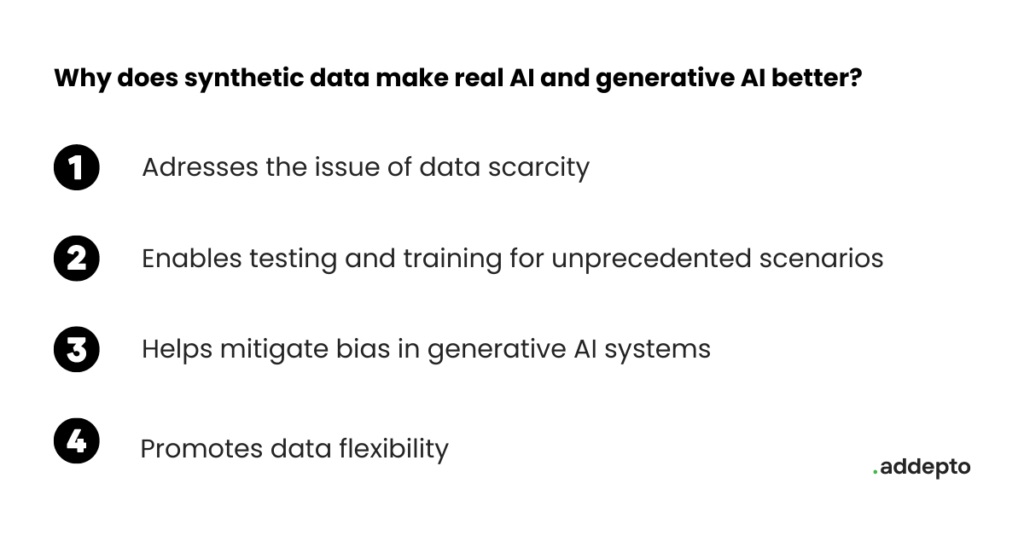
Adresses the issue of data scarcity
Data scarcity is one of the biggest problems facing the development of AI and ML models. Some of the biggest issues that lead to data scarcity are cost implications during the collection process, privacy and security concerns, and limited availability of data necessary to satisfy the needs of the model.
Synthetic data from generative AI models and other sources is not privy to privacy and security concerns since it does not affect any real person. It is also relatively cheap to produce at scale. Additionally, the development team fully controls the data creation process, thus enabling the creation of relevant data.
Enables testing and training for unprecedented scenarios
Performance testing is one of the most notable stages of the AI model development process. The process generally involves testing the model’s performance in specific environments and scenarios. Traditionally, this meant testing the models in real-world environments, which was often expensive and time-consuming.
But, with generative AI models, data scientists and other data engineering experts can simulate environments and test the models in various scenarios. If the model does not work as intended, you can always supplement the real-world data used to train the model initially with synthetic data in order to retrain it effectively.
Synthetic data can also be used to train machine learning and other AI models for dangerous or future scenarios where real-world data is unattainable or non-existent. This way, data engineering experts can generate more adaptive and futuristic AI models.
Helps mitigate bias in generative AI systems
At their core, AI systems are not inherently biased. As predictive analytics systems operate on big data, the bias issue in AI models arises from their training data. When the development team gathers data that isn’t accurately representative, it limits the model’s ability to provide accurate predictions.
Synthetic data can be used to reduce bias by creating more diverse and inclusive training data. This can include everything from representing minorities and marginalized groups to avoiding societal stereotypes that come with real-world data. [3]
Promotes data flexibility
Acquiring real-world data is a tedious, time-consuming, and expensive endeavor. Data engineering processes involving using real-world data often start with collecting the data, paying for annotations, and performing a review process to avoid copyright and privacy infringement.
Generative AI models can render literally anything you can think of. They can provide synthetic data on persons, scenarios, events, objects, and much more. The versatility of the data can also enable developers and researchers to discover niche applications, thus enabling them to explore limitless possibilities.
Undoubtedly, it makes generative AI better.
How do you make synthetic data for ML, data engineering, and generative AI?
There are several approaches for generating synthetic data. The approach you choose comes down to the type of synthetic data you want. For instance, synthetic statistical data can be generated through conventional means using special tools and software. In contrast, unstructured data like images, video, text, and audio are generated using generative AI models.
Here’s a simple breakdown of the processes:
Generative synthetic data through conventional methods
This is the most basic form of synthetic data generation. This method can benefit simple data engineering projects that don’t require complex datasets. It typically involves generating data using various tools and software. Organizations can also partner with third-party companies that offer synthetic data generation services.
Unfortunately, most synthetic data generated through conventional means isn’t suited for model performance but rather for testing purposes. Additionally, you need in-house specialized IT resources to leverage the data correctly.
Generating synthetic data using generative models
There are several generative models that can generate synthetic data. They include:
- Generative advisory networks
- Variational autoencoders
- Autoregressive models
Generative advisory networks
Generative advisory networks (GANs) are the most widely used generative models for generating synthetic data, and they are indispensable in generative AI. GANs models typically consist of two sub-models – a generator and a discriminator. The generator synthesizes the data while the discriminator verifies its authenticity. Therefore, the two systems work together to produce data that looks most real.
In order to increase its effectiveness, the generator is trained on real data to increase its accuracy in discerning real data from fake data. By following the discriminator’s ‘lead,’ the generator is better able to consistently generate data that ‘fools’ the discriminator into believing it’s real. [4]
For instance, if you want to create images of a person from a GANs model, you will have to train the discriminator with datasets containing images of real people so that it understands what real people look like. The next step is to feed the generator with instructions. The generator then synthesizes the images and sends them to the discriminator. Every time the discriminator tags an image as fake, the generator learns from the experience and gets better each time until it is able to generate images that look real.
Variational autoencoders
Variational autoencoders (VAEs) work by learning dependencies in the data, which enables them to reconstruct the data in different variations. This unique approach to data synthesis makes VAEs especially suitable for generating complex data sets like images, tabular data, and even human-like handwriting.
Autoregressive models
Autoregressive models (ARs) are mainly used to synthesize data sets with a time-based measurement. They typically create data by predicting future values based on past values. This makes them especially suitable for synthesizing data for use in predicting future events in economics and environmental changes.
How to improve the quality of data in ML
Data quality is a vital element of any machine learning model as it helps improve the model’s performance and accuracy. Some of the most effective ways of improving data quality in ML include:

Data cleaning
Data cleansing typically involves identifying and correcting errors, inconsistencies, and outliers in a given dataset. This includes everything from removing duplicate entries, handling missing values, correcting data entry errors, and addressing outliers that may negatively impact the model’s performance.
Feature engineering
Feature engineering can significantly improve the performance of a machine-learning model by improving underlying patterns and relationships in the data. The process typically involves selecting relevant features, encoding categorical variables, scaling numerical features, and creating interaction terms. [5]
Continuous monitoring and iterative improvement
Data monitoring is a continuous process. It doesn’t just stop at the development process. Therefore, you need to regularly review and validate the data in order to address emerging issues and incorporate necessary changes to the model to improve its performance.
Wrapping up on data in generative AI
Synthetic data is revolutionizing the machine learning model development process. It’s used in both generative AI and data engineering. Now, developers can instantly generate any form of data. Besides making the process faster and cheaper, it is also helping mitigate the issue of bias in AI. Developers can also synthesize different scenarios, thus broadening the possibilities and capabilities of AI and ML systems.
References
[1] Research.ibm.com. What is Synthetic Data. URL: ttps://research.ibm.com/blog/what-is-synthetic-data. Accessed May 15, 2023[2] Arxiv.org. The use of Synthetic Data to solve the scalability and data availability problems in Smart City Digital Twins. URL: https://arxiv.org/abs/2207.02953. Accessed May 15, 2023
[3] Thedrum.com. Synthetic Data Could Mitigate Privacy and Bias Issues for Marketers Using AI. URL: https://www.thedrum.com/news/2023/05/08/how-synthetic-data-could-mitigate-privacy-and-bias-issues-marketers-using-ai. Accessed May 15, 2023
[4] Analyticsvidhya.com. An End- to- end Introduction to Generative Adversarial Networks. URL: https://www.analyticsvidhya.com/blog/2021/10/an-end-to-end-introduction-to-generative-adversarial-networksgans/. Accessed May 16, 2023
[5] Serokell.io. URL: https://serokell.io/blog/feature-engineering-for-machine-learning